Solution
If the base of the football and frame are shared, $\boxed{h = 1}$.
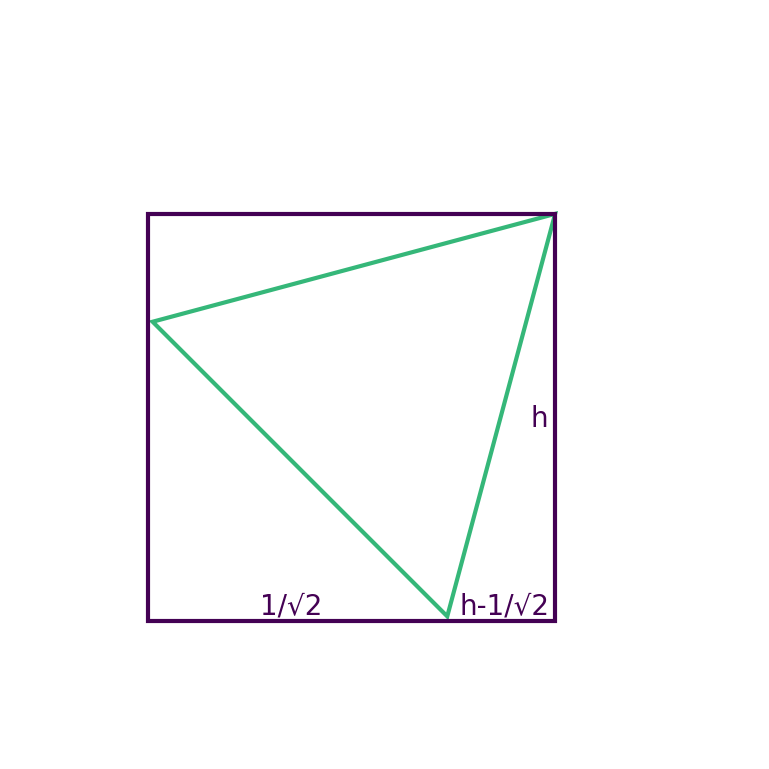
If the football and frame share a vertex and are diagonally symmetrical, $\boxed{h^2 + \left(h - \frac{1}{\sqrt2}\right)^2 = 1}$.
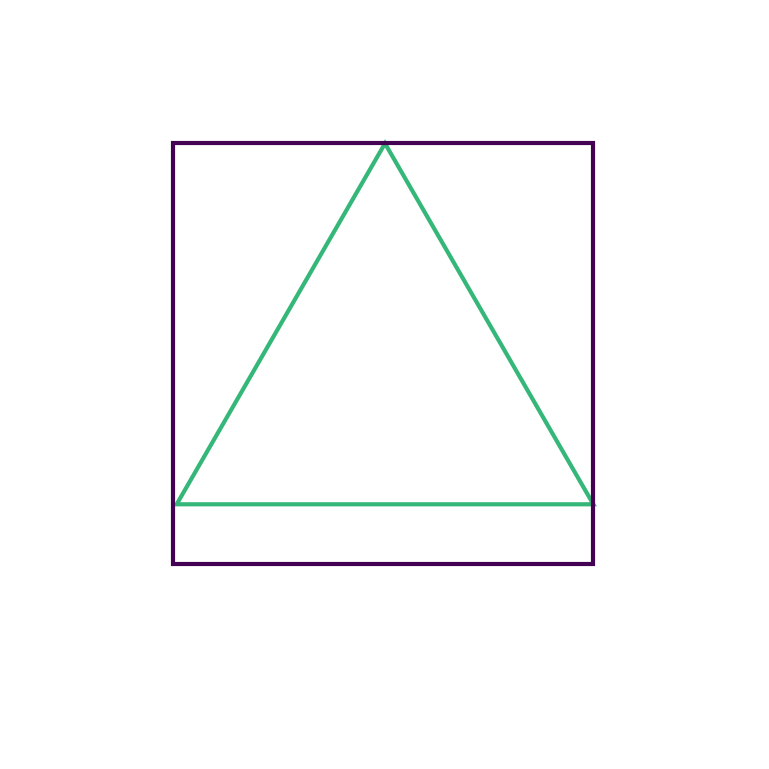
Congratulations—you just won your school’s tabletop football championship! You flicked your lucky paper football to victory countless times, and would now like to frame it for posterity.
The football is an equilateral triangle with a side length of 1 inch. What is the side length of the smallest square frame that will contain the football?
If the base of the football and frame are shared, $\boxed{h = 1}$.
If the football and frame share a vertex and are diagonally symmetrical, $\boxed{h^2 + \left(h - \frac{1}{\sqrt2}\right)^2 = 1}$.
To add a little excitement to the framing process, your new plan is to spin the triangular football by a random angle, and then frame it with a square that is not rotated. That is, the square consists of two perfectly horizontal sides and two perfectly vertical sides.
On average, what can you expect the side length of the smallest resulting square frame to be?
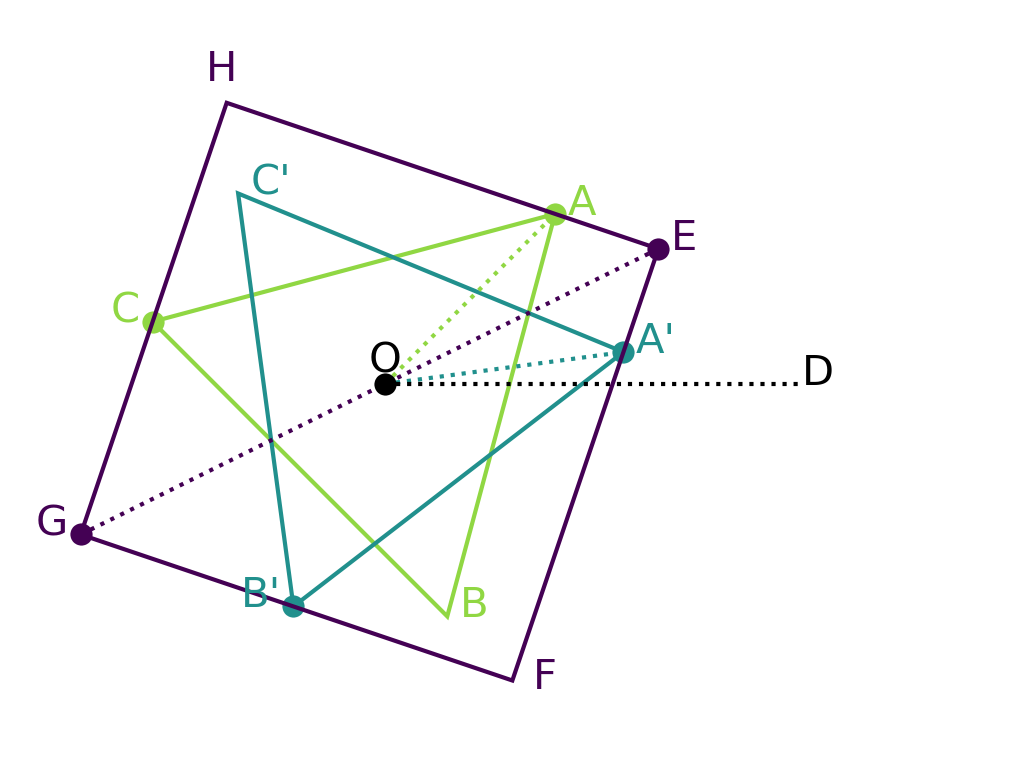
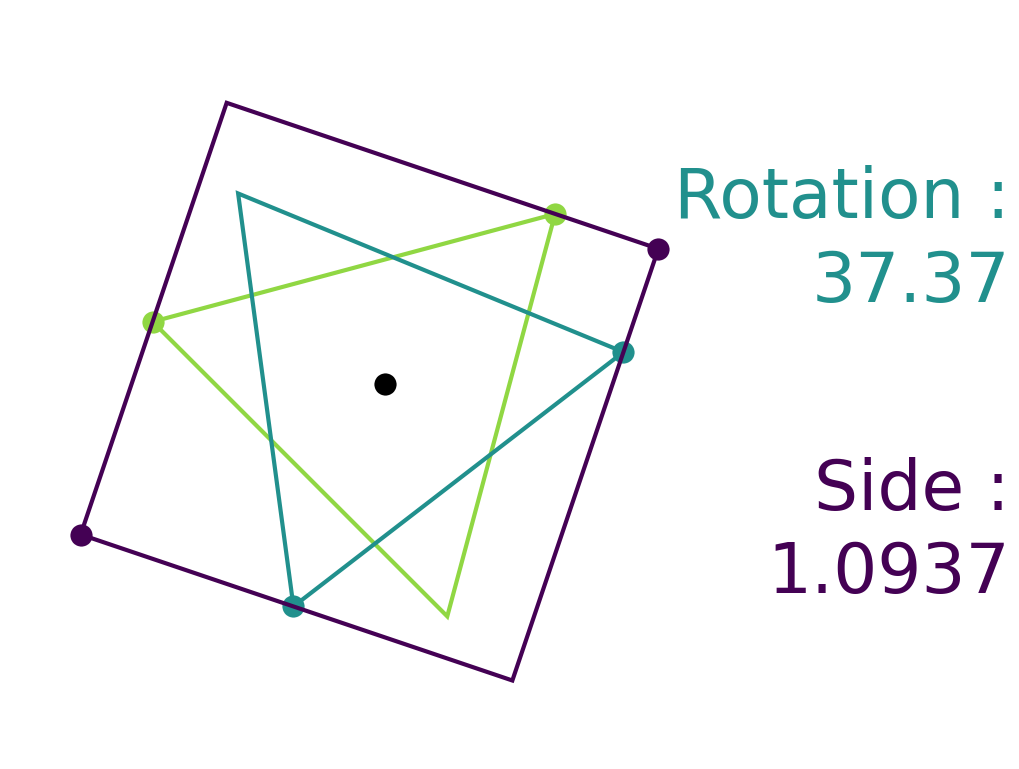
$\bigtriangleup ABC$ is rotated $\theta$ clockwise about $(0,0)$ to yield $\bigtriangleup A'B'C'$. $\square EFGH$ is the smallest square that contains both. $OD$ is the horizontal, for reference.
$\angle AOD = 45^\circ$ and $\angle A'OD = (45-\theta)^\circ$, thus $\angle EOD = (45-\frac{\theta}{2})^\circ$.
$\angle OEF = \angle OGF = 45^\circ$.
$OA = OA' = \dfrac{2}{3} \cdot \dfrac{\sqrt3}{2} = \dfrac{1}{\sqrt{3}}$
The equation of $EG$ is $\boxed{y = x\tan (45-\frac{\theta}{2})}$.
$EF$ has $m = (90-\frac{\theta}{2})^\circ$. Since $A' = \left(\dfrac{\sin (45-\frac{\theta}{2})}{\sqrt{3}}, \dfrac{\cos (45-\frac{\theta}{2})}{\sqrt{3}}\right)$, the equation of $EF$ is
$$\boxed{y - \dfrac{\cos (45-\frac{\theta}{2})}{\sqrt{3}} = \tan (90-\frac{\theta}{2}) \cdot \left(x - \dfrac{\sin (45-\frac{\theta}{2})}{\sqrt{3}}\right)}$$Similarly, $FG$ has $m = (180-\frac{\theta}{2})^\circ$. Since $B' = \left(\dfrac{\sin (165-\frac{\theta}{2})}{\sqrt{3}}, \dfrac{\cos (165-\frac{\theta}{2})}{\sqrt{3}}\right)$, the equation of $FG$ is
$$\boxed{y - \dfrac{\cos (165-\frac{\theta}{2})}{\sqrt{3}} = \tan (180-\frac{\theta}{2}) \cdot \left(x - \dfrac{\sin (165-\frac{\theta}{2})}{\sqrt{3}}\right)}$$I then used the intersection of $EG$ & $EF$ to determine $E$ and $EG$ & $FG$ to determine $G$. The frame side is $\dfrac{EG}{\sqrt{2}}$.
I averaged $12,000$ values from $0.00 \le \theta \le 119.99$ to get $\boxed{1.0651}$.