Can You Win at Asymmetric Bingo?
Fiddler
From Austin Shapiro (and his 7-year-old kid!) comes a two-player game that … might be competitive?
In a game of “asymmetric bingo,” you and your opponent have two differently sized boards: You play on a 5×5 board, while your opponent has an 8×8 board. The 8×8 board has 64 squares, collectively marked with the numbers 1 through 64 in some random arrangement. Meanwhile, the 5×5 board is populated with 25 numbers chosen and arranged randomly (without replacement) from 1 through 64. There are no “free” squares like there are in traditional bingo.
Here’s how the game works: One at a time, a number from 1 to 64 is drawn randomly, without replacement. If that number appears on your 5×5 board, you place a marker on the corresponding square. Otherwise, your opponent (who is guaranteed to have that number somewhere on their board) places the marker on their corresponding square.
The game ends when one of you has “bingo,” meaning five markers in a row going across, down, or diagonally somewhere on the board.
Who is more likely to win this game: you (with the 5×5 board) or your opponent (with the 8×8 board)?
Solution
There are 8 rows, 8 columns, and 2 diagonals on the 8x8 Board. If at least one of the numbers in any of those lines is on the 5x5 board, that line is no longer a potential win.
I ran 1 million trials of randomly selecting numbers from 1-64. See EC for code.
Answer
~77% of the time, there are no lines left on the 8x8 Board that can result in a win. The 5x5 Board has the advantage.
Extra Credit
From Austin also comes the following Extra Credit:
To at least the nearest hundredth, what is the probability that you’ll win a given game of asymmetric bingo?
Answer
I solved a general case of you playing on a $M \times M$ board and your opponent on a $N \times N$ board.
Since the $M \times M$ numbers as well as the game play numbers are chosen randomly, WLOG, assume the $N \times N$ board is in order from $1-N^2$.
- Start with :
- The above stated $N \times N$ Board :
- Create $N$ lists representing its rows.
- Create $N$ lists representing its columns.
- Create $2$ more lists representing its diagonals
- Create an $M \times M$ Board :
- Create a list of $2M+2$ lists representing the $M$ rows, $M$ columns, and $2$ diagonals on the $M \times M$ Board
- From a list of numbers from $1 - N^2$:
- Randomly select a number and remove it from that list.
- Going from $1-M$ for both the row and column location, place the number in the appropriate location in the row, column, and if applicable, diagonal lists.
- Remove the lists in the Big Board that contain that number.
- Repeat to create the $M \times M$ Board.
- The above stated $N \times N$ Board :
- Play Bingo!:
- Create two lists representing the numbers in each of the $M\times M$ and $N\times N$ boards, respectively.
- Create a list containing $2M + 2$ lists for wins on the $M \times M$ Board and a list containing the number of lists corresponding to potential win lines on the Big Board. These represent potential to win.
- From a list of numbers from $1 - N^2$:
- Check if the number is on the $M\times M$ or $N\times N$ Board.
- If it is, append a $1$ to the potential lists that contain that number. Check if that list has $M$ or $N$ $1$s.
- If it does, a winner is declared. Break out and start with a new $M \times M$ board.
- If not, continue to next number.
- If not, the number was on a non useful line on the Big Board. Continue to next number
- If it is, append a $1$ to the potential lists that contain that number. Check if that list has $M$ or $N$ $1$s.
- Check if the number is on the $M\times M$ or $N\times N$ Board.
- Note that if there are no potential lines on the $N \times N$ Board (Related to Fiddler problem), $M \times M$ board wins by default!
Solution
I ran $1,000,000$ trials of randomly creating a $M \times M$ Board. If the win were not by default, I ran $1,000$ trials of that particular $M \times M$ Board with a random number selection for order of gameplay.
I achieved $\boxed{0.99157}$ as the probability of you winning.
Extra Extra Credit
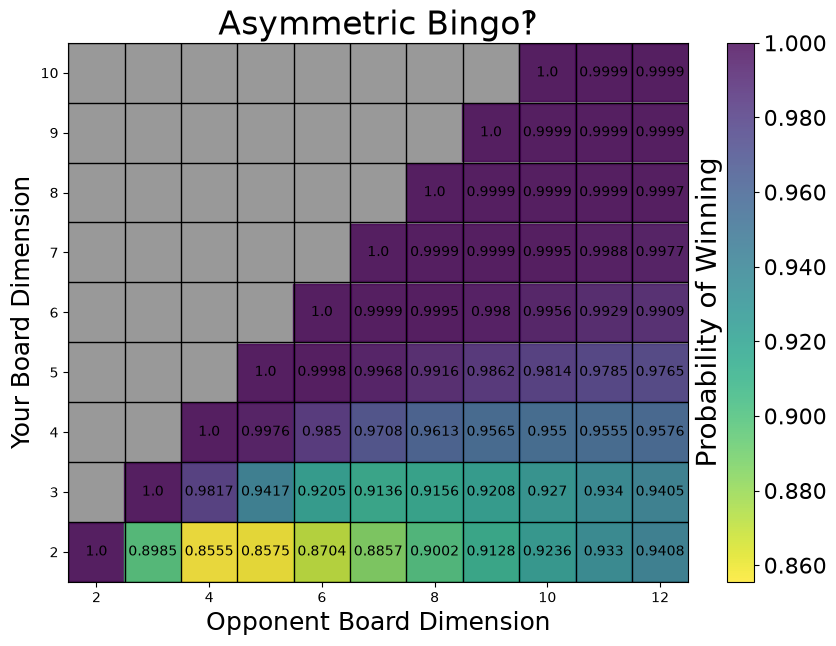
I explored various $M \times M$ vs. $N \times N$ Boards.
For each $(M, N)$ combination, I ran $10,000$ trials of $M\times M$ Board and $2,000$ trials of gameplay for each non-default win. There is clearly an advantage to playing the smaller board!