How Far Can You Roll?
Fiddler
For her photography show, Frederica Fiddleria attaches a light to a point on the circumference of a circular wheel with a radius of 1 meter. She points a camera at the wheel and, during a single long exposure, rolls the wheel for one revolution along the ground.
When she develops the film, she is curious about the path the light took as the wheel rolled. What is the length of this path?
Solution
Let the center of the circle initially be at $(0, 0)$. Let the initial position of the light be at $(0, -1)$. Since the circle rolls along its circumference, the final position of the center is $(2\pi, 0)$.
The following diagram traces the path.
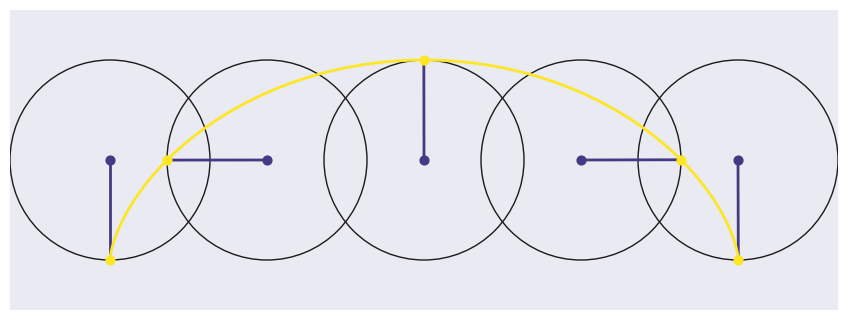
Let $\theta$ represent how much the wheel has rolled. The coordinates of the light are the coordinates of a point moving along a circle's circumference with an additional horizontal shift. This can be parametrically expressed as
\begin{align*}
x(\theta) =& \text{ }\theta - \sin{\theta} \\
y(\theta) =& - \cos{\theta} \\
\end{align*}
The arc length can be found by solving :
\begin{align*} L =& \int\limits\sqrt{\left(x'(\theta)\right)^2 + \left(y'(\theta)\right)^2} \cdot d\theta \\ =& \int\limits_{\theta=0}^{2\pi}\sqrt{\left(1 - \cos{\theta}\right)^2 + \left(\sin{\theta}\right)^2} \cdot d\theta \\ =& \int\limits_{\theta=0}^{2\pi}\sqrt{1 -2\cos{\theta} + \cos^2{\theta} + \sin^2{\theta}} \cdot d\theta \\ =& \int\limits_{\theta=0}^{2\pi}\sqrt{2 -2\cos{\theta}} \cdot d\theta \\ =& 2\cdot\int\limits_{\theta=0}^{2\pi}\sqrt{\dfrac{1 - \cos{\theta}}{2}} \cdot d\theta \\ =& 2\cdot\int\limits_{\theta=0}^{2\pi}\sin{\dfrac{\theta}{2}} \cdot d\theta \\ =& 2\cdot \left[-2\cdot\cos{\dfrac{\theta}{2}}\right]_0^{2\pi} \\ \end{align*}
Answer
$$\boxed{-4 \cdot \left[\cos{\pi}-\cos{0}\right] = 8} $$
Extra Credit
For her next show, Frederica wants to mix things up. Instead of placing the light on the circumference of the wheel, she will pick a random point inside the circle. (Before you ask, let me clarify what “random” means here: Any two regions with the same area are equally likely to contain the point.)
As before, she will roll the wheel for one revolution along the ground and capture the motion with a single long exposure on her camera. On average, what can she expect the length of the path to be?
Solution
The coordinates are now:
\begin{align*}
x(\theta) =& \text{ }\theta - r\sin{\theta} \\
y(\theta) =& - r\cos{\theta} \\
\end{align*}
where $r$ is the distance of the light to the center of the circle.
In order to have a uniform distribution, the weight of each ring at $\text{radius} = r$ is $2\pi r$. Thus, the integral to be solved is:
\begin{align*}
\text{Avg} =& \dfrac{1}{\pi R^2} \cdot \int\limits_{r=0}^1 2\pi r\cdot\int\limits_{\theta=0}^{2\pi}\sqrt{\left(1 - r\cos{\theta}\right)^2 + \left(r\sin{\theta}\right)^2} \cdot d\theta\cdot dr \\
=& 2 \cdot \int\limits_{r=0}^1 r\cdot\int\limits_{\theta=0}^{2\pi}\sqrt{1 - 2r\cos{\theta} + r^2} \cdot d\theta\cdot dr
\end{align*}
Answer
I could not solve the double integral. However, I could solve the first integral for specific values of $r$.
I evaluated the following two summations for $R = 10,000,000$.
$$\dfrac{1}{R} \cdot \sum\limits_{r=0}^R\int\limits_{\theta=0}^{2\pi}\sqrt{\left(1 - \sqrt{\dfrac{r}{R}}\cos{\theta}\right)^2 + \left(\sqrt{\dfrac{r}{R}}\sin{\theta}\right)^2} \cdot d\theta$$
$$\dfrac{1}{\frac{R^2+R}{2}} \cdot \sum\limits_{r=0}^R r\cdot\int\limits_{\theta=0}^{2\pi}\sqrt{\left(1 - \dfrac{r}{R}\cos{\theta}\right)^2 + \left(\dfrac{r}{R}\sin{\theta}\right)^2} \cdot d\theta$$
Both evaluated to $\boxed{ \approx 7.111111}$.
Given that, the Fiddler answer being $8$, the mean distance of a point in a circle to the center is $\dfrac{2}{3}$, so I am guessing $\boxed{\dfrac{64}{9}}$.