Can You Sneak Past the Rings?

Fiddler

From Randi Goldman comes a riddle of rings:

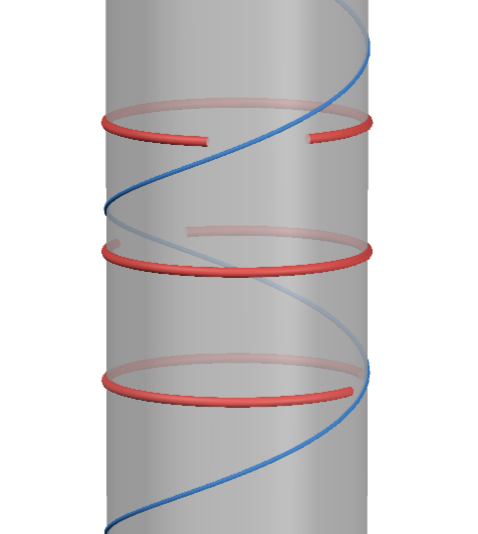
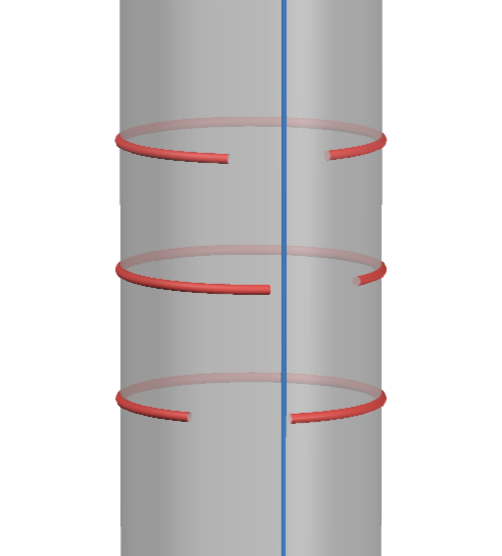
A long vertical cylinder has three narrow open rings, each of which wraps around seven-eighths of the cylinder (leaving a one-eighth “gap”). The rings are evenly spaced vertically, but are otherwise randomly rotated about the cylinder’s central axis. For some orientations of the rings, there exists at least one vertical line down the cylinder’s surface that passes through each ring’s gap, as illustrated below.

What is the probability that at least one such vertical line exists?

Solution

From top to bottom, denote the rings as $A$, $B$, and $C$. Relative to the cross section of the cylinder, each ring has a gap which begins at $\theta_A$, $\theta_B$, $\theta_C$, and ends at $\theta_A + \dfrac{\pi}{4}$, $\theta_B + \dfrac{\pi}{4}$, $\theta_C + \dfrac{\pi}{4}$, respectively.

WLOG, set $\theta_B = 0$. Relative to the cross section of the cylinder, the vertical line is constrained by $0 \le \theta_l \le \dfrac{\pi}{4}$.

$\theta_A$ is constrained by $-\dfrac{\pi}{4} \le \theta_A \le \dfrac{\pi}{4}$ in order to have a vertical line shared with with Ring $B$. Because of symmetry, $-\dfrac{\pi}{4} \le \theta_A \le 0$ will be used for calculations going forward.

Ring $C$ has a range of $\dfrac{\pi}{4}$ to rotate in order to allow the vertical line to pass through it. The vertical line is constrained now by $0 \le \theta_l \le \theta_A+\dfrac{\pi}{4}$.

Thus,

\begin{align*} P &= 2\times \dfrac{1}{2\pi}\times\int\limits_{a = -\frac{\pi}{4}}^{0} \dfrac{a + \frac{\pi}{4}+ \frac{\pi}{4}}{2\pi} da \\ &= \dfrac{1}{2\pi^2} \Bigg[\dfrac{a^2}{2} + \dfrac{\pi a}{2} \Bigg]_{a = -\frac{\pi}{4}}^{0} \\ &= \dfrac{1}{2\pi^2} \bigg(\big(0 + 0 \big) - \big(\dfrac{\pi^2}{32} - \dfrac{\pi^2}{8} \big)\bigg) = \dfrac{3}{64} \\ \end{align*}
Answer

$$\boxed{\dfrac{3}{64} \approx 4.69\%}$$

Extra Credit

Instead of requiring a vertical line down the cylinder’s surface, now any helix down the surface is allowed. An example of such a helix passing through all three gaps is shown below.

What is the probability that there exists at least one such helix that can pass through each ring’s gap?

Solution

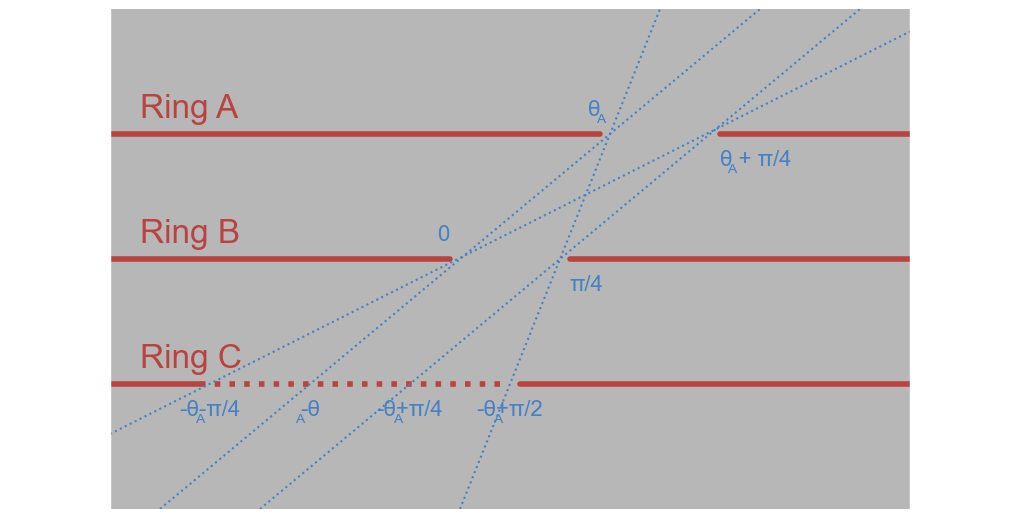
Because the rings are evenly spaced, the location the point where the helix crosses Ring $C$'s path can be found by rotating where the helix crosses Ring $A$'s path about where the helix crosses Ring $B$'s path. It doesn't matter how many times the helix loops around nor which direction it traverses.


  1. $0 - (\theta_A+\dfrac{\pi}{4}-0) = \boxed{-\theta_A-\dfrac{\pi}{4}}$
  2. $0 - (\theta_A-0) = \boxed{-\theta_A}$
  3. $\dfrac{\pi}{4} - (\theta_A +\dfrac{\pi}{4}-\dfrac{\pi}{4}) = \boxed{-\theta_A+\dfrac{\pi}{4}}$
  4. $\dfrac{\pi}{4} - (\theta_A -\dfrac{\pi}{4}) = \boxed{-\theta_A+\dfrac{\pi}{2}}$

Thus, $-\theta_A-\dfrac{\pi}{2} \le \theta_C \le -\theta_A-\dfrac{\pi}{2}$

Answer

$$\boxed{\dfrac{\dfrac{2\pi}{2}}{2\pi}=\dfrac{1}{2} = 50\%}$$

Rohan Lewis

2026.08.03