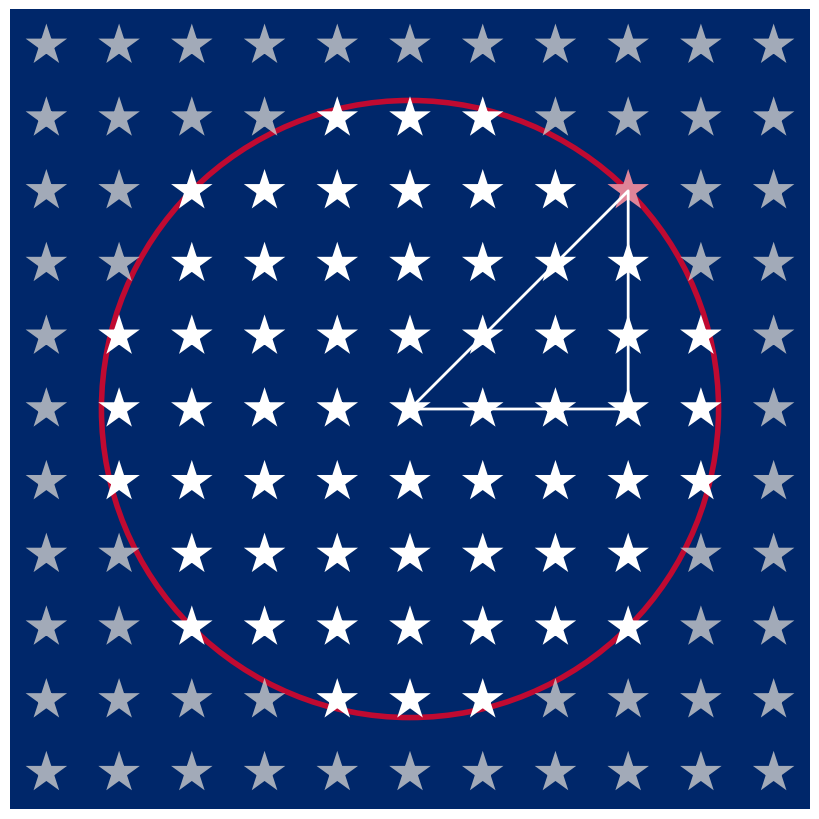
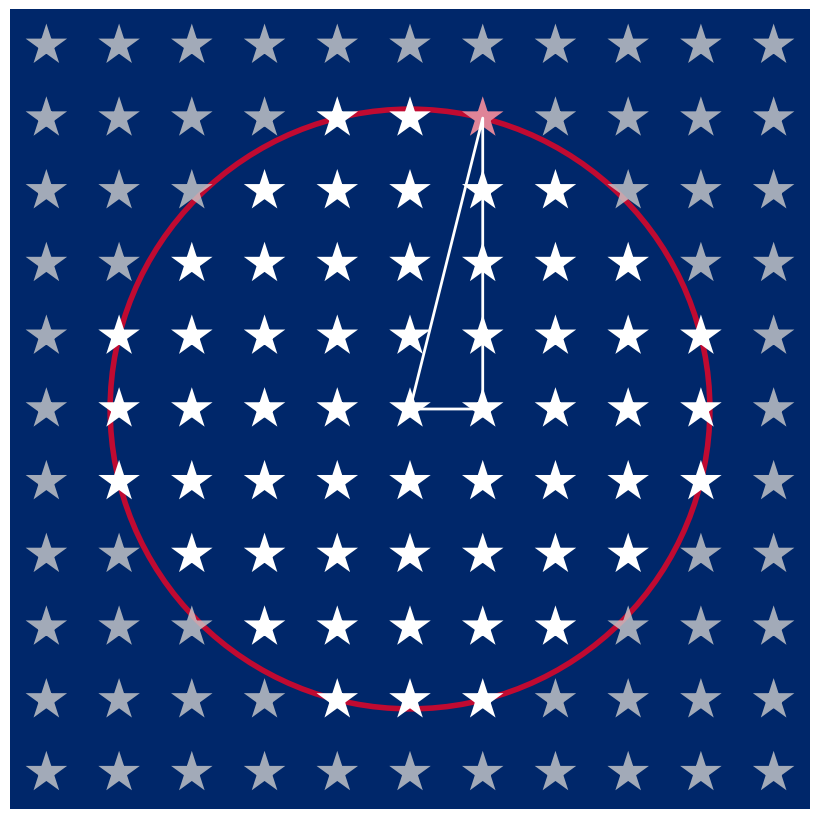
When designing her new nation’s flag, Retsy Boss wanted to compactly arrange some stars. These stars were positioned along a square grid, but she only wanted to include stars whose centers were at most two units away from some point on the plane.
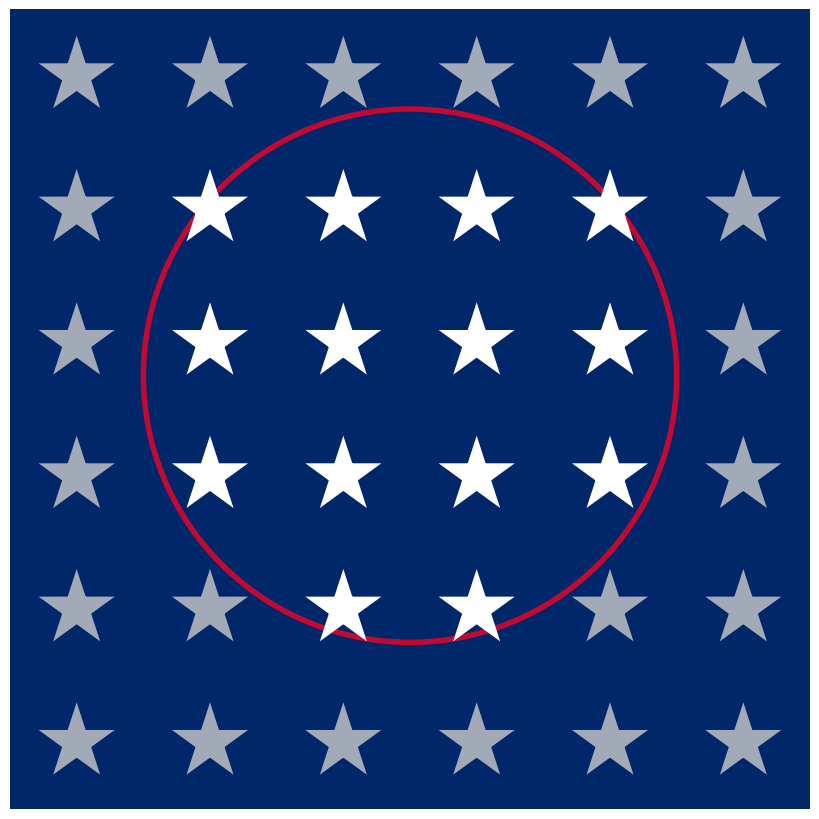
For example, if she had centered the circle on a star itself, then she could have placed a total of 13 stars on the flag, as shown below:
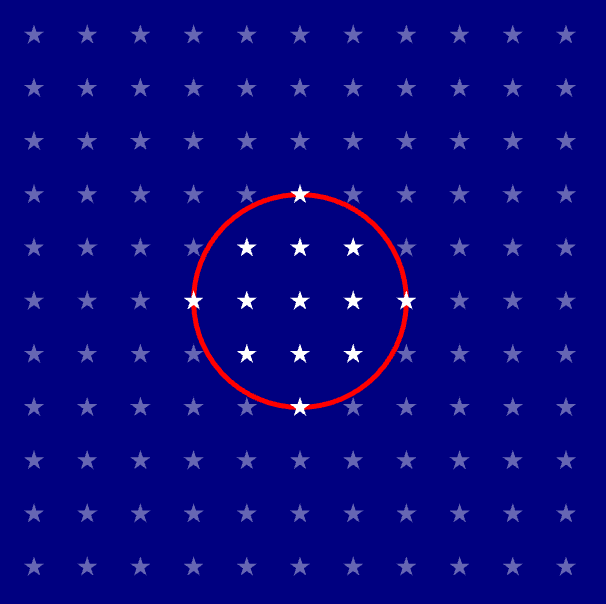
What is the greatest number of stars Retsy could have placed on the flag?
$6$ stars in a horizontal or vertical line would be a distance of $5$, too large for the give distance.
Similarly, $4$ stars in a diagonal line would be a distance of $3\sqrt{2} \approx 4.2$, also too large.
A $4x4$ square omitting two adjacent corners would be feasible.
After 250 years, the nation has commissioned Retsy Boss VIII to design a new flag with one star for each of the nation’s current 58 states. As an homage to the original flag design, Retsy wants to select 58 stars from the square grid that are all at most some distance R from a point on the plane.
What is the minimum distance R that Retsy can use?
A $7\times7$ square array with an additional $3$ stars on each side of the square yields $\boxed{61 \text{ stars}}$ in a radius of $\boxed{3\sqrt{2} \approx 4.243 \text{ units}}$.
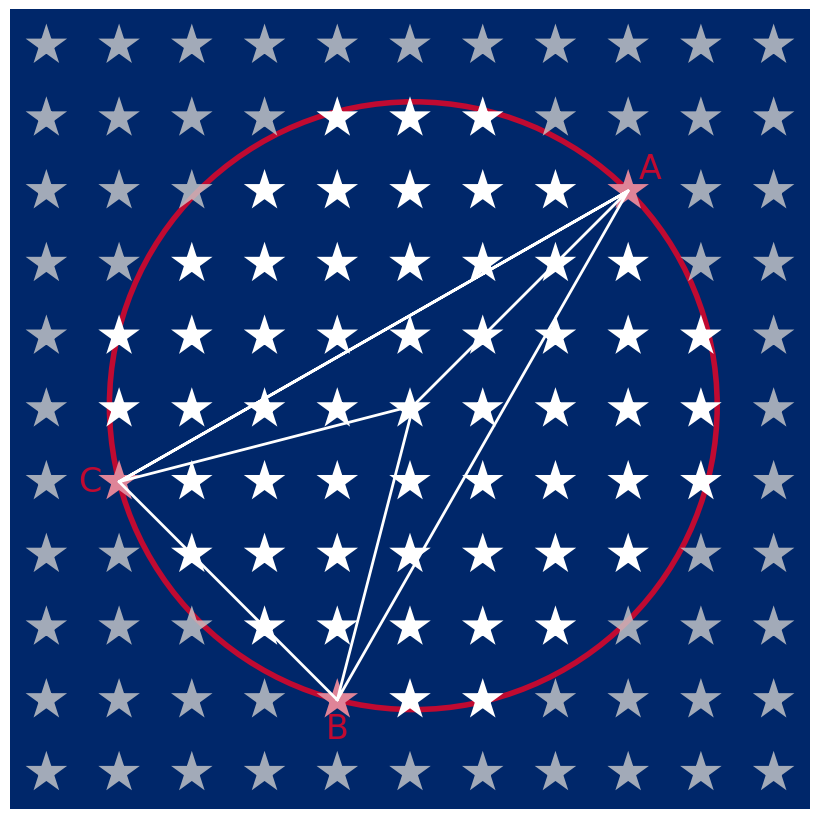
Give the vertices $\text{A } (3, 3)$, $\text{B } (-1, -4)$, and $\text{C } (-4, -1)$, the circumcenter can be found using matrices.
\begin{align*} x, y &= \dfrac{\begin{bmatrix}|A|^2 & A_y & 1 \\ |B|^2 & B_y & 1 \\ |C|^2 & C_y & 1\end{bmatrix}}{2\begin{bmatrix}A_x & A_y & 1 \\ B_x & B_y & 1 \\ C_x & C_y & 1\end{bmatrix}}, \dfrac{\begin{bmatrix}A_x & |A|^2 & 1 \\ B_x & |B|^2 & 1 \\C_x & |C|^2 & 1\end{bmatrix}}{2\begin{bmatrix}A_x & A_y & 1 \\ B_x & B_y & 1 \\ C_x & C_y & 1\end{bmatrix}} \\ \\ &= \dfrac{\begin{bmatrix}18 & 3 & 1 \\ 17 & -4 & 1 \\ 17 & -1 & 1\end{bmatrix}}{2\begin{bmatrix}3 & 3 & 1 \\ -1 & -4 & 1 \\ -4 & -1 & 1\end{bmatrix}}, \dfrac{\begin{bmatrix}3 & 18 & 1 \\ -1 & 17 & 1 \\ -4 & 17 & 1\end{bmatrix}}{2\begin{bmatrix}3 & 3 & 1 \\ -1 & -4 & 1 \\ -4 & -1 & 1\end{bmatrix}} \\ &= \dfrac{-3}{2\left(\dfrac{-1}{33}\right)}, \dfrac{-3}{2\left(\dfrac{-1}{33}\right)} \\ &= \boxed{\dfrac{1}{22}, \dfrac{1}{22}} \\ \end{align*}The circumradius is the distance from any of $A$, $B$, $C$, to $\left(\dfrac{1}{22}, \dfrac{1}{22}\right)$.
Using $(3, 3)$,
\begin{align*} R &= \left(3 - \dfrac{1}{22}\right)\sqrt{2} \\ &= \boxed{\dfrac{65}{11\sqrt{2}} \approx 4.1784} \end{align*}