Solution
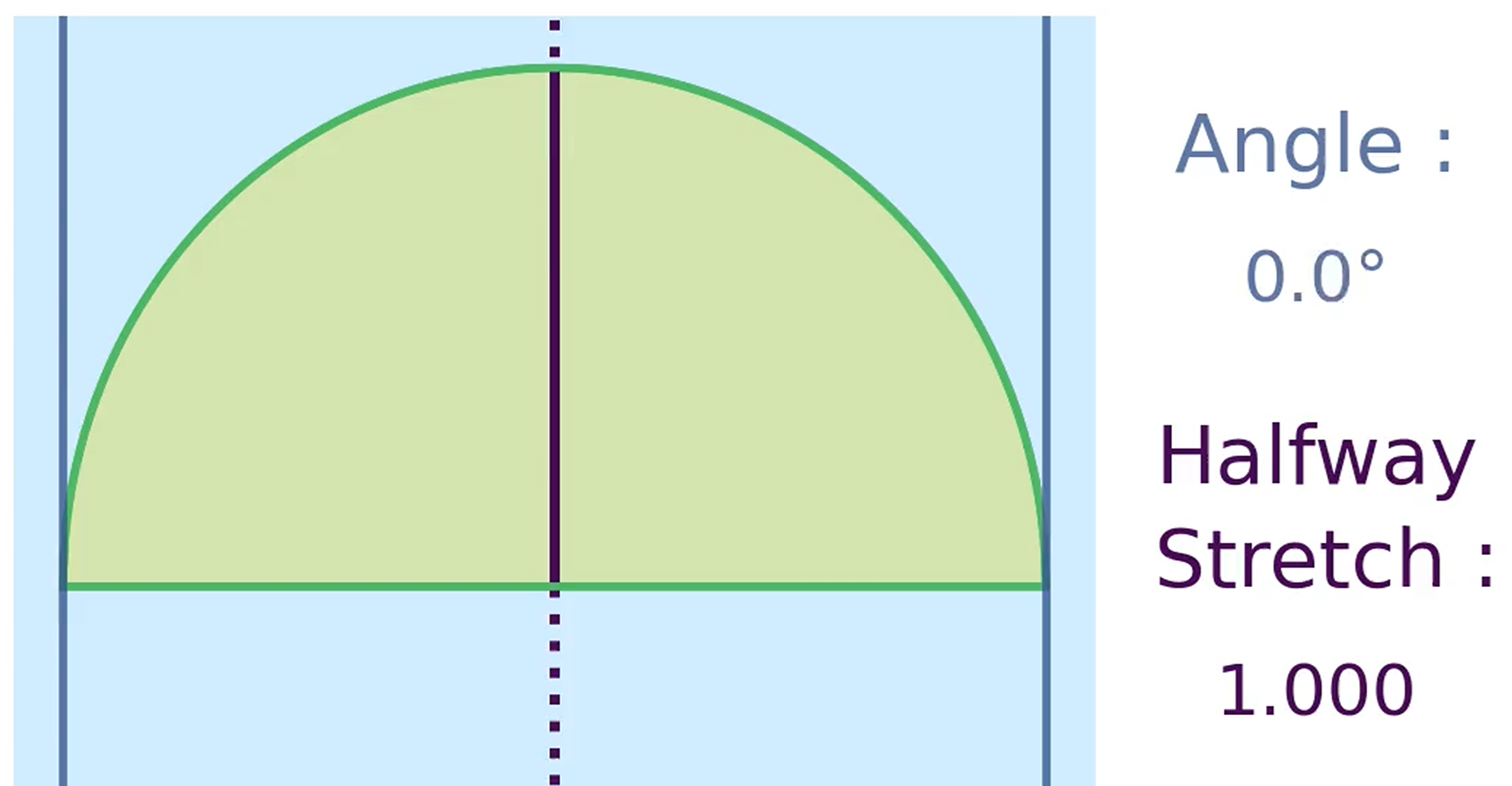
The longest stretch of land must pass through one of the vertices. Let $\alpha$ be the angle perpendicular to the direction of the wave.
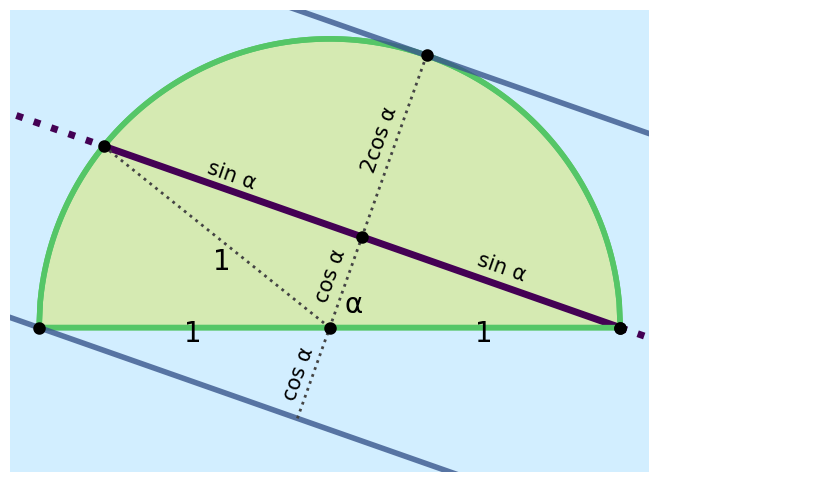
Semicircle Island is shaped like a perfect semicircle (or semidisk, technically), with a radius of 1 mile. It doesn’t have any permanent residents, but it’s a very popular destination for surfers.
Rumor has it that a big wave is headed toward the island, but no one knows which direction it’s coming from. This thin, straight wall of water never changes speed or direction. It will first make contact with the island at 10 a.m. and it will last be in contact with the island at 10:10 a.m.
What is the longest possible stretch of land that is directly under the wave at 10:05 a.m.?
The longest stretch of land must pass through one of the vertices. Let $\alpha$ be the angle perpendicular to the direction of the wave.
Another wave is approaching the island, but again no one knows which direction it’s coming from—for the moment, all directions are equally likely. For example, it might come in the direction illustrated below:
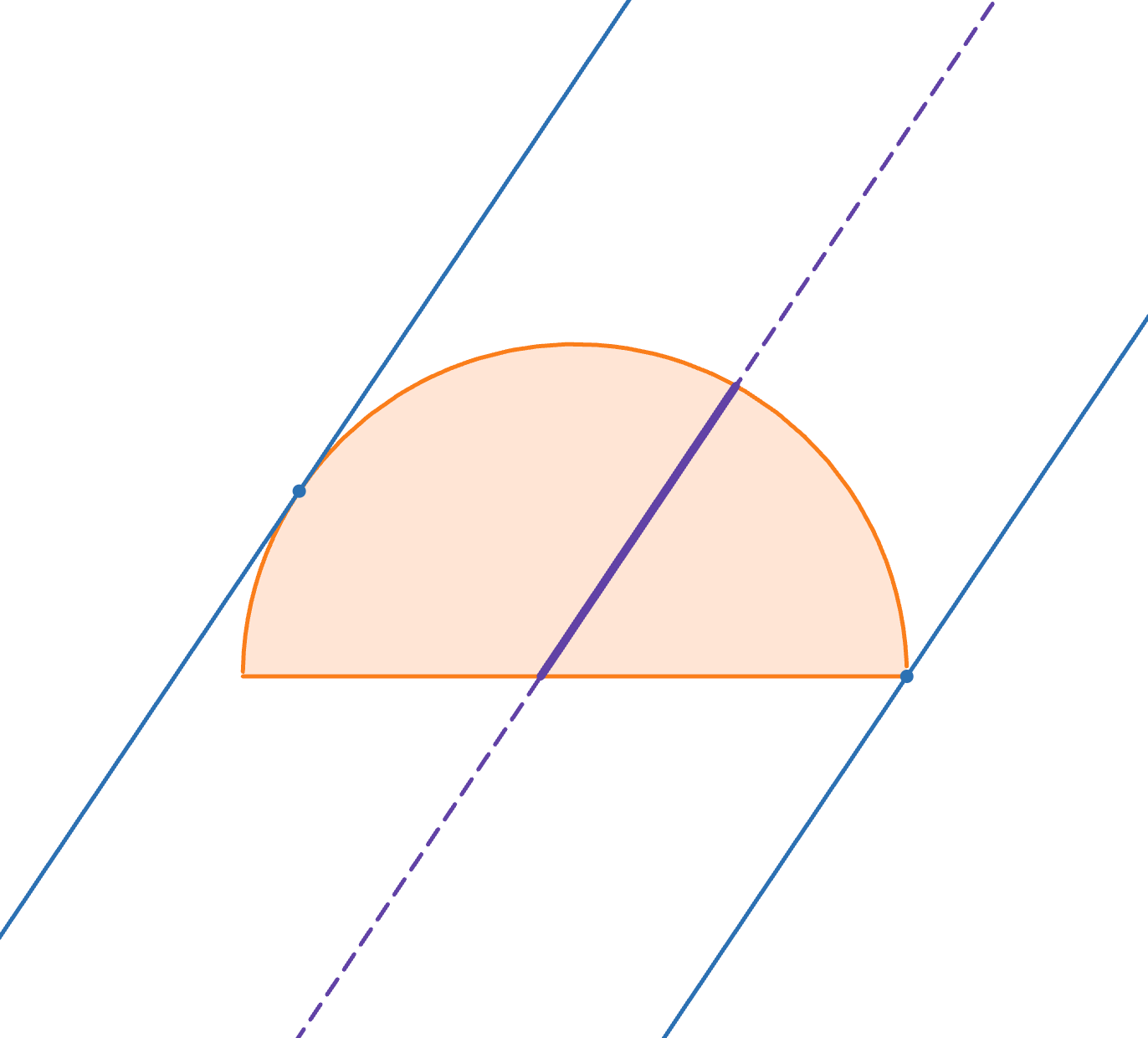
On average, what is the length of the stretch of land directly under the wave halfway between when the wave first and last makes contact with the island?
Because the $10:05$ stretch of land is identical if the first and last contact points are switched. The island is also symmetric, thus an integral on $[0, \frac{\pi}{2}]$ is sufficent.
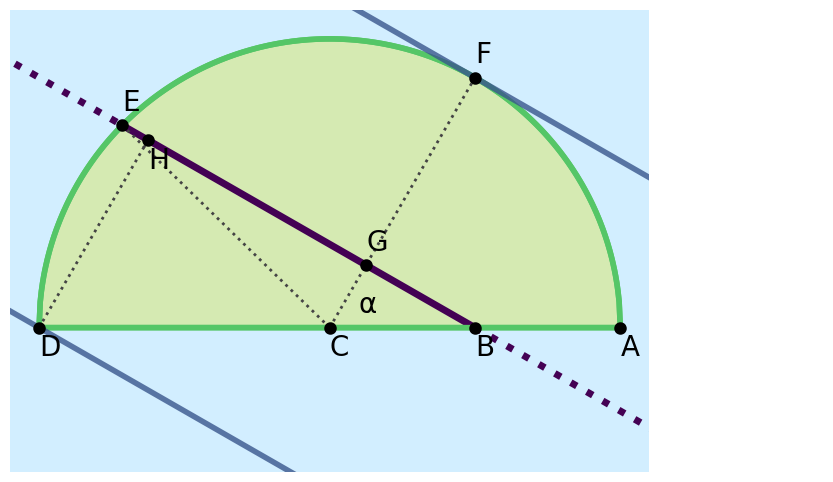
Given the diagram above, $CA = CD = CF = 1$, $DH = GF$, $\alpha = \angle GCB$. The coordinates of $F$ are $(\cos \alpha, \sin \alpha)$. Since $C$ is the center, let the coordinates of $G$ be $(a\cos \alpha, a\sin \alpha)$. Since $DH = GF$, it follows that the coordinates of $H$ are $\big(-1 + (1-a)\cos \alpha, (1-a)\sin \alpha\big)$. Since the slope of $HB$ is $-\cot \alpha$,
\begin{align*} -\frac{\cos\alpha}{\sin\alpha} &= \frac{(1-a)\sin \alpha - a\sin \alpha}{-1 + (1-a)\cos \alpha - a\cos \alpha} \\ \cos \alpha - (1-a)\cos^2 \alpha + a\cos^2 \alpha &= (1-a)\sin^2 \alpha - a\sin^2 \alpha \\ \cos \alpha &= (1-2a)(\cos^2 \alpha + sin^2 \alpha) \\ a &= \boxed{\frac{1-\cos\alpha}{2}} \end{align*}Similarly, the x-ordinate of $B$ can be determined.
\begin{align*} -\frac{\cos\alpha}{\sin\alpha} &= \frac{0-a\sin \alpha}{b - a\cos \alpha} \\ -b\cos\alpha + a\cos^2 \alpha &= -a\sin^2 \alpha \\ a &= b\cos \alpha \\ b &= \boxed{\frac{1-\cos\alpha}{2\cos \alpha}} \\ \end{align*}Note that $E$ can be expressed as $\left(\cos \beta, \sin \beta\right)$.
\begin{align*} -\frac{\cos\alpha}{\sin\alpha} &= \frac{\sin \beta - a\sin \alpha}{\cos \beta - a\cos \alpha} \\ -b\cos\alpha + a\cos^2 \alpha &= -a\sin^2 \alpha \\ a\cos^2 \alpha - \cos \alpha \cos \beta &= -a\sin^2 \alpha + \sin \alpha \sin \beta \\ a &= \sin \alpha \sin \beta + \cos \alpha \cos \beta \\ a &= \cos(\beta - \alpha) \\ \beta &= \boxed{\alpha + \cos^{-1} a} \\ \end{align*}The distance $EB$ is,
$$\boxed{\sqrt{\bigg(\cos(\alpha + \cos^{-1} a) - \frac{a}{\cos \alpha}\bigg)^2 + \big(\sin(\alpha + \cos^{-1} a)\big)^2}}$$However, this is true for $0 \le \alpha \le 1.2301$.
For $1.2301 \le \alpha \le \dfrac{\pi}{2}$,
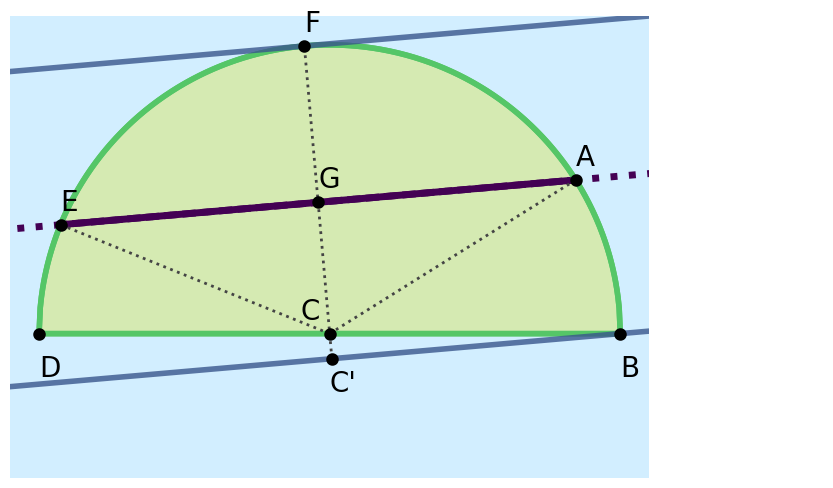
Given the diagram above, $\angle ECG = \angle ACG = \beta$. Thus, $EA = 2\sin \beta$.
I averaged 9,000,000 values of the 10:05 wave from $0 \le \alpha \le \dfrac{\pi}{2}$.