Can You Shovel the Snow?

Fiddler

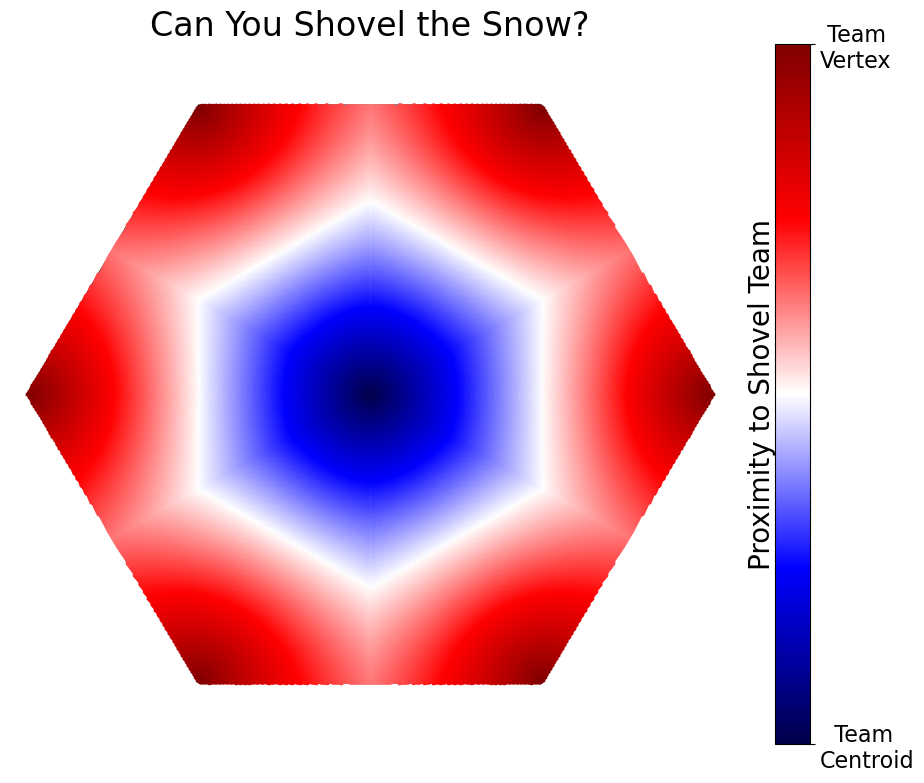
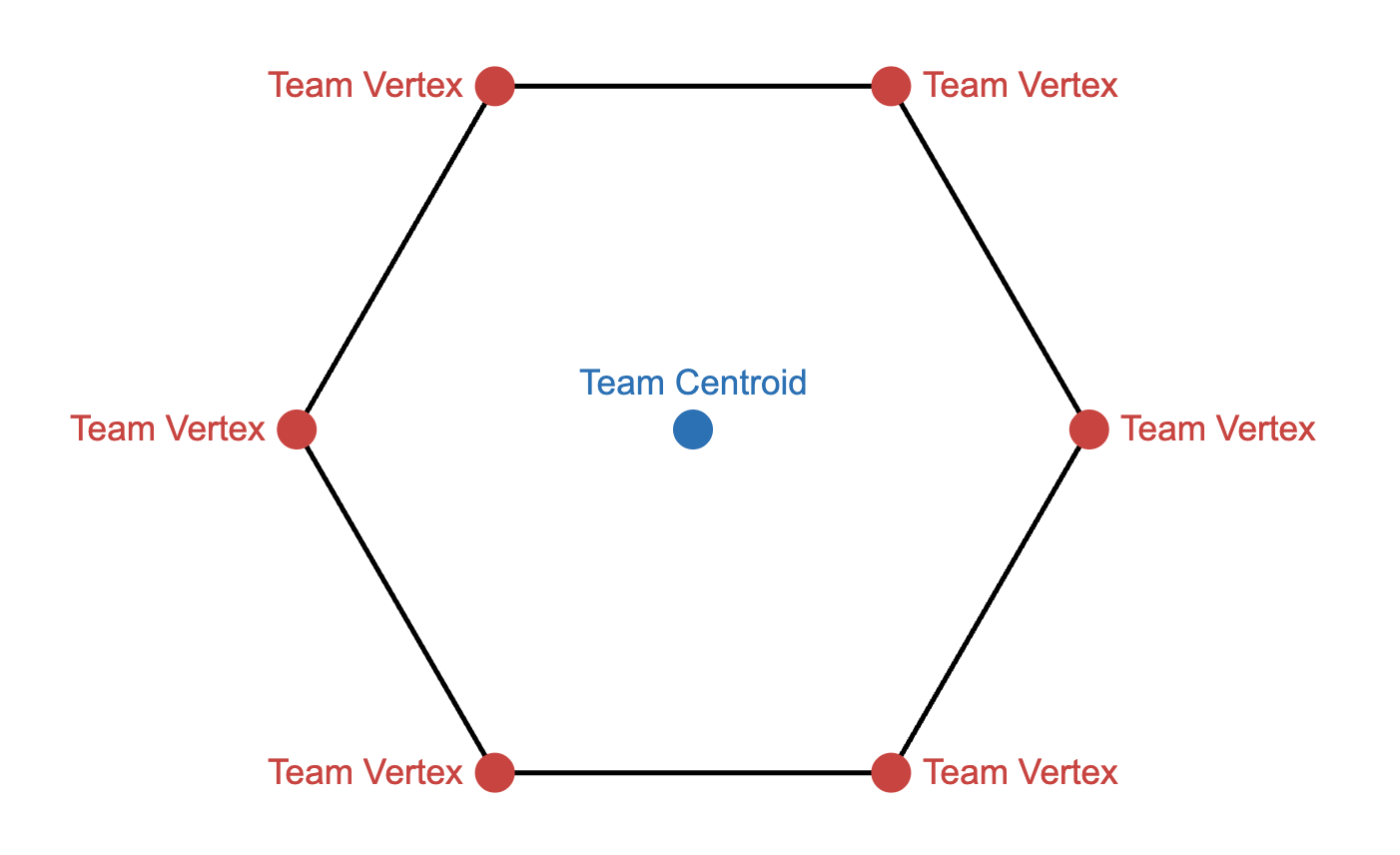
Two teams of shovelers plan to remove all the snow from a parking lot that’s shaped like a regular hexagon. Team Vertex initially places each of its six shovelers at the six corners of the lot. Meanwhile, Team Centroid initially places all its shovelers at the very center of the lot.

Each team is responsible for shoveling the snow that is initially closer to someone on their own team than anyone on the other team.

What fraction of the lot’s snow is Team Centroid responsible for shoveling?

Solution

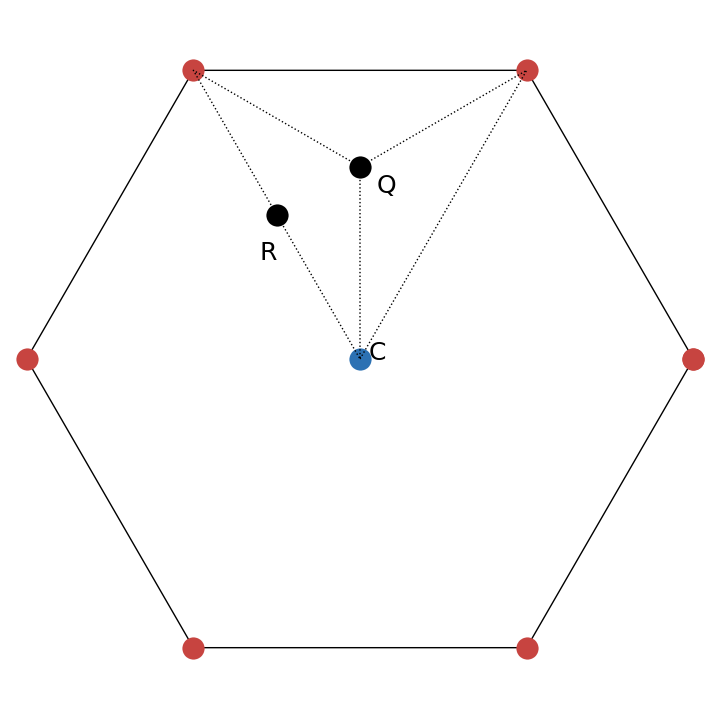
$Q$ and $R$ are equidistant from Team Centroid and the nearest Team Vertex.

Given a hexagon of side length 1, $RC = \frac{1}{2}$ and $QC = \frac{1}{\sqrt{3}}$.

Answer

Team Centroid's shoveling region is a hexagon $\boxed{\frac{1}{3}}$ the area of the original.

Extra Credit

Having completed the shoveling of the hexagonal lot, the two teams move on to a circular lot. This time, Team Vertex initially places all their shovelers at one random point inside the circle, while Team Centroid initially places all their shovelers at one other, independently chosen random point inside the circle. (To be clear, by “random point” in the circle, I mean that the probability of being in any given region of the circle is proportional to that region’s area.)

As before, each team is responsible for shoveling the snow that is initially closer to someone on their own team than anyone on the other team.

Inevitably, one team is responsible for shoveling a greater fraction of the lot than the other. On average, what would you expect this greater fraction to be?

Solution


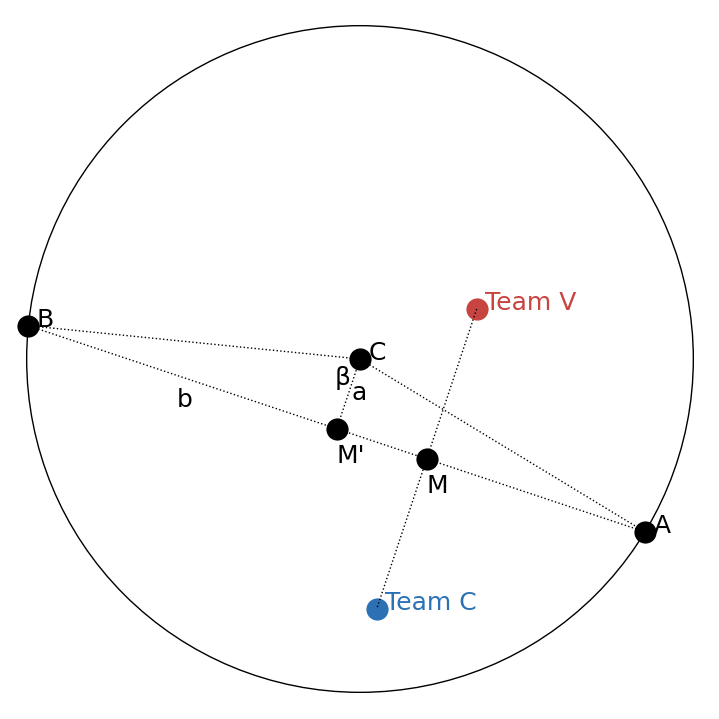
$M$ is the midpoint of the two teams. $AB$ is the chord passing through $M$ perpendicular to the segment between the two teams.
$M'$ is the midpoint of $AB$.

Right $\bigtriangleup ACM'$ has $\angle BCM' = \beta$, $CM' = a$, and $BM' = b$.
It follows that $a = \cos \beta$ and $b = \sin \beta$.
Given Team Centroid at $(x_c, y_c)$ and Team Vertex at $(x_v, y_v)$ :

  • $(x_M, y_M) = \left(\dfrac{x_c+x_v}{2}, \dfrac{y_c+y_v}{2}\right)$.
  • $m = \dfrac{y_c-y_v}{x_c-x_v}$ between the two teams' centers.
  • The equation of $AB$ is $y - y_M = -\frac{1}{m}(x-x_M) \implies \frac{1}{m}x + y + (-\frac{1}{m}x_M-y_M) = 0$.
  • $a$ is the minimum distance from the center to $AB$.
  • $a = \dfrac{\bigg|\dfrac{1}{m}x_M+y_M\bigg|}{\sqrt{\dfrac{1}{m^2}+1}} = \dfrac{|x_M+my_M|}{\sqrt{1+m^2}}$.
  • The area of $\bigcirc C = \pi$ and the area of sector $ACB = \beta$.
  • $a = \sin\beta$.
  • The area of $\bigtriangleup ABC = \frac{1}{2}2b\cdot a = \frac{1}{2} \cdot 2\sin \beta \cos \beta = \frac{1}{2} \sin 2\beta$.

Thus, the area of the larger region bounded by chord $AB$ and major arc $AB$ is $\boxed{\pi - \beta + \frac{1}{2} \sin 2\beta}$.
Answer

I ran a simulation of 100 million random radiis and angles corresponding to the radii of one team, and the radii and angle of the other team. I took the square root of the random number for the radii both times to account for the probability density of a circle. The larger region averages to $$\boxed{0.6398}$$

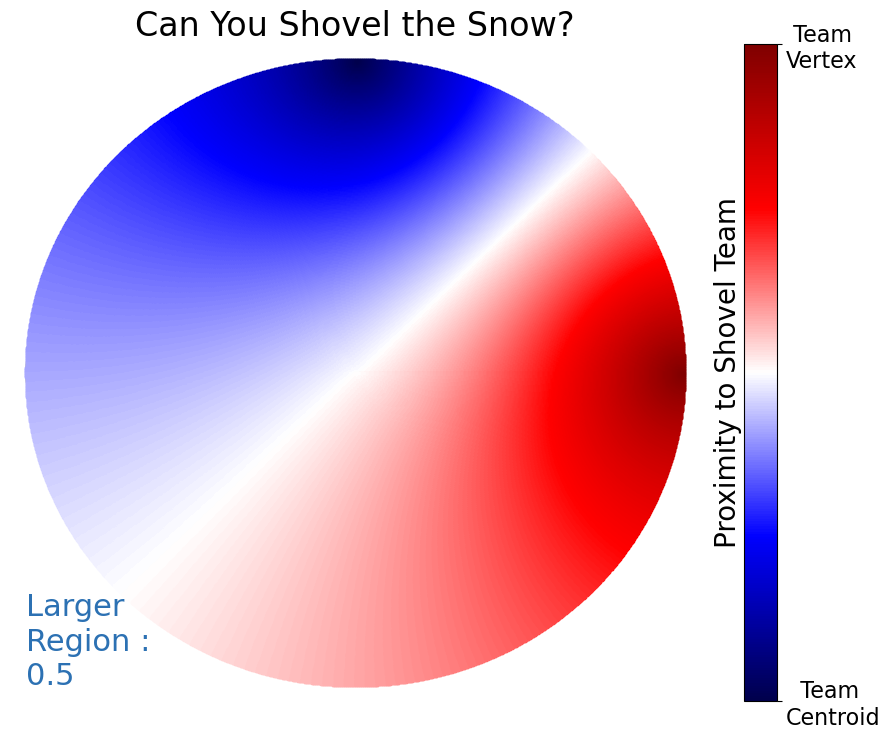
I rendered an animation where Team Centroid travels along the vertical diameter of the circle while Team Vertex travels along an Archimidean Spiral through exactly 3 revolutions.

"Proximity" of a point is defined by :
$$\dfrac{d_{Centroid} - d_{Vertex}}{d_{Centroid} + d_{Vertex}}$$
This gives a smooth colormap from $-1$ to $1$. As a random point is relatively further away from the midpoint of the two teams, "Proximity" approaches $0$.
This is apparent if the two teams are relatively close together.

Rohan Lewis

2026.03.09

Code can be found here.