From Bart Wright comes a tale of two archers:
Two logicians are trying to earn a fabulous prize as a team. There are three targets, and, to win the prize, each logician must fire a single arrow and hit the same target as the other. Two of the targets are closer but are otherwise indistinguishable; the logicians know they each have a 98 percent chance of hitting either of these targets. The third target is farther away; the logicians know they each have a 70 percent chance of hitting that target.
The logicians can’t cooperate or consult in advance, and they have no knowledge of which target their counterpart is aiming for or whether they are successful.
What is the probability they will win the prize?
Both logicians know:
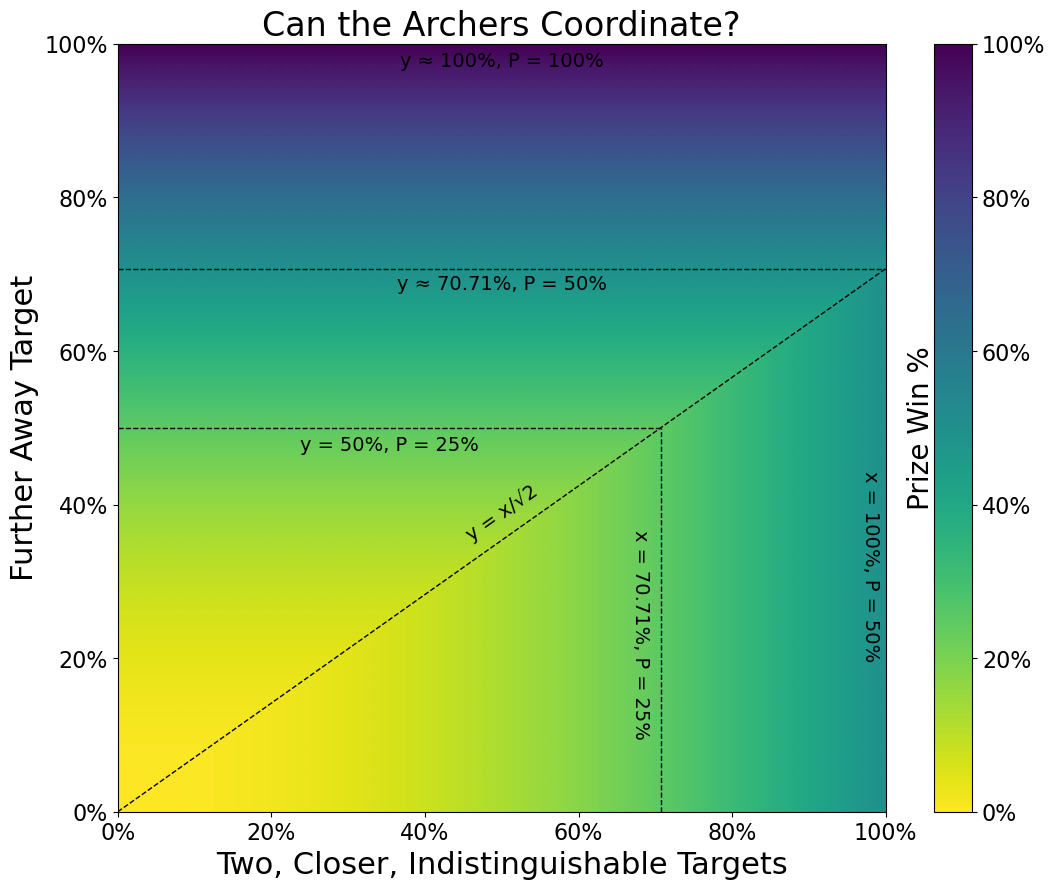
Setting $x$ as the probability of hitting either of the two indistinguishable targets and $y$ as the farther away target, the general form of winning for each of the above outcomes is:
Comparing the last two,
\begin{align*}
\dfrac{2x^2}{4} \lt& y^2\\
\dfrac{x}{\sqrt{2}} \lt& y\\
\end{align*}
Note that $\frac{0.98}{\sqrt{2}} \approx 0.693$.
Both should aim for the farther away target, yielding a win probability of $$\boxed{0.49}$$
As before, there are still three targets, but their respective probabilities of being struck have changed. That said, two of the targets remain indistinguishable from each other and have the same probability of being struck. Moreover, all three probabilities are rational.
After doing some mental arithmetic, the logicians realize that it doesn’t matter which target they aim for—their probability of winning the prize is the same no matter what.
What is their probability of winning the prize?
Th probability that they win is 0?