A max spice level of $2^h + 1$ has the most sets for any $N$.
This makes a fascinating graph. Notice that even and odd values have two 'parallel' curves.
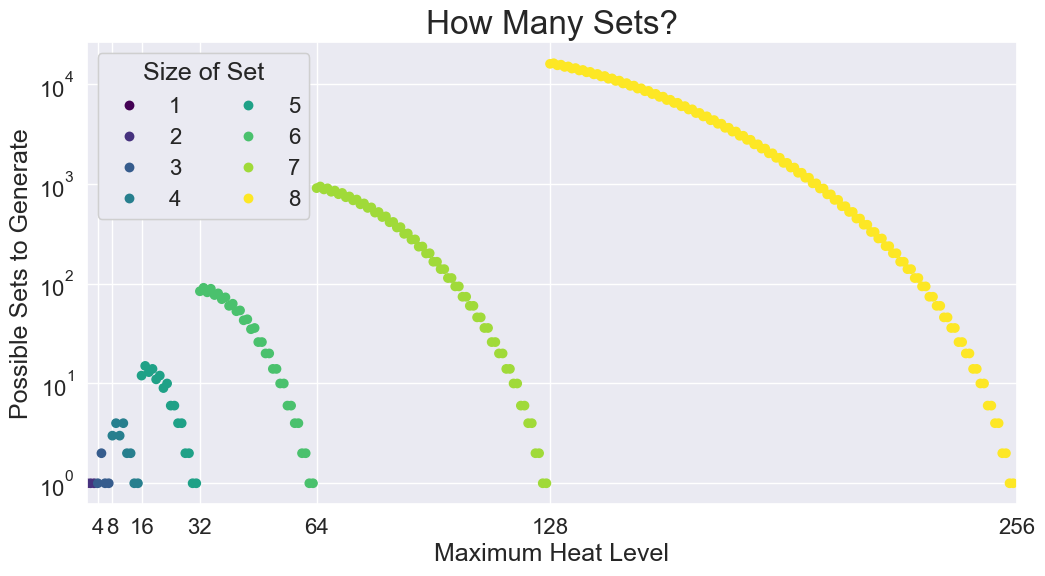
Max spice levels of $256$ and $257$ have a whopping $462,664$ and $465,297$ sets!
In the YouTube show, “Hot Ones,” guests answer interview questions while consuming 10 hot sauces, one at a time, ranked in increasing spiciness from 1 to 10.
You have been invited on as a guest and want to prepare for the show. However, you don’t feel like purchasing all 10 sauces in advance. Your plan is to purchase fewer sauces, and then to combine sauces together for any you are missing. For example, if you are missing sauce #7, then you can instead simultaneously consume sauces #3 and #4, since 3 + 4 = 7. (I know the spiciness of the sauces isn’t linear, but for the purposes of this puzzle, let’s assume it is.)
After some pencil-and-paper scratch work, you realize you only need four spices. For example, here’s how you can generate all the values from 1 to 10 using the spices #1, #2, #3, and #4 at most once:
1
2
3
4
5 = 1 + 4
6 = 2 + 4
7 = 3 + 4
8 = 1 + 3 + 4
9 = 2 + 3 + 4
10 = 1 + 2 + 3 + 4
Including this particular set of four spices (i.e., #1 through #4), for how many sets of four spice numbers is it possible to generate all the numbers from 1 to 10 using each spice at most once?
The largest number cannot be more than 6.
If the largest number is 5, $\boxed{\text{#1, #1, #3, #5}}$ and $\boxed{\text{#1, #2, #2, #5}}$ can generate all 10 spice levels.
If the largest number is 4, $\boxed{\text{#1, #2, #3, #4}}$ can generate all 10 spice levels.
The largest number cannot be 3, as #1, #3, #3, #3 cannot generate spice level 2 and #2, #2, #3, #3 cannot generate spice level 1.
There are 3 sets of four spice numbers.
You’re prepping for a new show, “Hotter Ones,” which has spices ranked from 1 to 100. Let N be the minimum number of spices needed to generate all the numbers from 1 to 100.
For how many sets of N spice numbers is it possible to generate all the numbers from 1 to 100 using each spice at most once? (Note that I am not asking for the value of N; that’s just something you’ll need to figure out en route to your answer.)
I first determined that a max spice level of $2^h-1$ has only one set, $[1,2,4, \cdots, 2^{h-1}]$. This helped defined the value of $N$ for all numbers.
A spice level can appear a maximum of two times.
I wrote code that did the following :
For $h = 100$, $N = 7$, and there are $\boxed {114}$ unique sets to achieve all values from $1$ to $100$.
A max spice level of $2^h + 1$ has the most sets for any $N$.
This makes a fascinating graph. Notice that even and odd values have two 'parallel' curves.
Max spice levels of $256$ and $257$ have a whopping $462,664$ and $465,297$ sets!